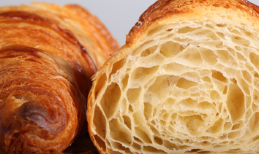
🥐 Authentic Homemade French Croissants
Buttery, Flaky, Golden Perfection
Introduction
Few things in the culinary world inspire as much reverence as a true French croissant. Crisp and shatteringly flaky on the outside, honeycombed and tender on the inside, rich with butter yet impossibly light—this is not just bread, it’s an experience. Born in France and perfected in Parisian boulangeries, croissants are a triumph of technique, time, and quality ingredients.
Making croissants at home is absolutely possible, but it requires patience, precision, and respect for the process. This is not a “quick recipe”—it’s a weekend ritual, a slow dance between dough and butter. If you follow each step carefully, you’ll pull a tray of bakery-level croissants from your oven that will make your kitchen smell like a Paris morning.
🧺 Ingredients (Makes 12–14 croissants)
For the Dough (Détrempe)
- 500 g all-purpose flour (or French T55 flour if available)
- 10 g salt
- 60 g granulated sugar
- 10 g instant dry yeast
- 300 ml cold whole milk
- 40 g unsalted butter, softened
For the Butter Block (Beurrage)
- 280 g high-quality unsalted butter (European-style, minimum 82% fat)
- 1 tablespoon flour (optional, helps stability)
For the Egg Wash
- 1 large egg
- 1 tablespoon milk or cream
- Pinch of salt
🥖 Step 1: Preparing the Dough
In a large bowl, mix the flour, sugar, salt, and yeast. Keep the salt and yeast on opposite sides at first—salt can weaken yeast if added directly on contact.
Gradually pour in the cold milk and mix until a shaggy dough forms. Add the softened butter and knead for about 5–6 minutes, just until the dough becomes smooth and elastic. This is not a fully developed bread dough—avoid overkneading.
Shape the dough into a rectangle, wrap tightly in plastic wrap, and refrigerate for at least 2 hours, preferably overnight. Cold dough is essential for successful lamination.
🧈 Step 2: Preparing the Butter Block
Place the cold butter between two sheets of parchment paper. Using a rolling pin, gently pound and roll it into a flat rectangle about 18 x 12 cm (7 x 5 inches).
The butter should be pliable but still cold. If it becomes too soft, refrigerate it briefly. If it’s too hard, let it rest at room temperature for a minute. Butter and dough must be similar in consistency—this is crucial.
Refrigerate the butter block until ready to use.
🧊 Step 3: Enclosing the Butter (Lamination Begins)
Remove the chilled dough and roll it into a rectangle about twice the size of your butter block. Place the butter in the center and fold the dough over it like an envelope, sealing the edges carefully.
Roll gently into a long rectangle, keeping edges straight and thickness even. Take your time—rushing will cause butter leakage.
🔁 Step 4: The Turns (Creating the Layers)
First Turn (Single Fold)
- Roll the dough into a long rectangle.
- Fold the bottom third up, then the top third down (like folding a letter).
- Wrap and refrigerate for 30–45 minutes.
Second Turn
Repeat the rolling and folding process. Keep everything cold. Chill again for 30–45 minutes.
Third Turn
Repeat once more. After the final fold, refrigerate for at least 1 hour, preferably longer.
At this point, your dough contains dozens of butter layers that will puff dramatically in the oven.
📐 Step 5: Rolling and Shaping
Roll the chilled dough into a large rectangle about 4 mm thick. Trim the edges for clean layers.
Cut long triangles with a base of about 9 cm (3.5 inches). Make a small slit in the center of each base—this helps the croissant curl properly.
Starting from the base, roll each triangle tightly but gently toward the tip. Curve slightly into a crescent shape and place on a parchment-lined baking tray, tip tucked underneath.
⏳ Step 6: Proofing
Cover the croissants loosely with plastic wrap or a clean towel. Let them proof at 24–26°C (75–78°F) for 2–3 hours, until noticeably puffy and jiggly.
Do not rush this step. Proper proofing ensures airy layers and a tender crumb. Avoid heat—if the butter melts, the layers will be lost.
🥚 Step 7: Egg Wash
Whisk the egg, milk, and salt. Brush gently over the croissants, avoiding the cut edges (egg wash can seal layers).
For best results, apply two thin coats, one before proofing and one just before baking.
🔥 Step 8: Baking
Preheat your oven to 200°C (390°F).
Bake croissants for 18–22 minutes, rotating the tray halfway, until deeply golden brown with visible flaky layers.
Do not open the oven too early—steam is essential for lift.
🌬️ Cooling
Transfer croissants to a wire rack and let cool for at least 15 minutes. This allows the interior crumb to set and prevents sogginess.
🧠 Tips for Perfect Croissants
- Butter quality matters more than anything
- If butter leaks, chill immediately and continue
- Croissants freeze beautifully before baking
- Use a ruler—precision helps consistency
- Patience beats speed every time
🥐 Serving Suggestions
Serve warm with:
- Salted butter and apricot jam
- Dark chocolate squares
- Fresh fruit and café au lait
Or turn them into:
- Almond croissants
- Ham & cheese croissants
- Breakfast sandwiches
❤️ Final Thoughts
Homemade croissants are not just food—they’re craftsmanship. The process teaches patience, respect for ingredients, and trust in technique. When you bite into that crisp shell and hear the gentle crackle before hitting buttery softness, you’ll understand why croissants are sacred in French baking.