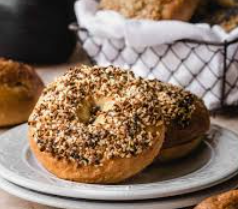
New York–Style Bagels
Chewy, shiny, dense, and unmistakably authentic
New York–style bagels are legendary. Unlike bread rolls or fluffy bagel imitations, true New York bagels are dense yet tender, with a chewy crumb and a glossy, slightly crisp crust. Their distinctive texture comes from a unique process: high-gluten dough, long fermentation, boiling before baking, and just the right balance of malt sweetness and salt.
This recipe stays faithful to traditional methods used in classic New York bagel shops. While it requires patience, the result is worth every minute—bagels that rival those from any NYC bakery.
Ingredients (makes 8 large bagels)
Dough
- 500 g bread flour or high-gluten flour (very important)
- 10 g fine sea salt
- 7 g instant yeast (or 9 g active dry yeast)
- 20 g barley malt syrup
(or honey if malt is unavailable, but malt is traditional) - 260 ml warm water (about 38°C / 100°F)
Boiling Bath
- 2 liters water
- 2 tablespoons barley malt syrup or honey
- 1 tablespoon baking soda (optional, for extra shine)
Optional Toppings
- Sesame seeds
- Poppy seeds
- Dried onion flakes
- Dried garlic
- Everything bagel seasoning
- Coarse salt
Equipment
- Stand mixer (optional)
- Large mixing bowl
- Baking sheet
- Parchment paper
- Slotted spoon
- Cooling rack
Step 1: Mixing the Dough
In a large bowl, combine the flour, salt, and yeast. Keep the salt and yeast separate at first, then mix together. Add the barley malt syrup to the warm water and stir until dissolved.
Pour the liquid into the dry ingredients and mix until a rough dough forms. The dough should feel stiff and dense, not soft like sandwich bread dough. This stiffness is essential for chewiness.
If using a stand mixer, knead with a dough hook for about 8–10 minutes. If kneading by hand, expect about 12–15 minutes of firm kneading.
The finished dough should be smooth, elastic, and slightly tacky—but not sticky.
Step 2: Kneading and Gluten Development
Proper gluten development is what gives bagels their signature bite. When kneaded enough, the dough should pass the windowpane test: stretch a small piece thin enough to let light through without tearing.
Form the dough into a tight ball and place it in a lightly oiled bowl. Cover and let it rest at room temperature for 1 hour, just until slightly puffed—not doubled.
Step 3: Shaping the Bagels
Turn the dough onto a clean surface and divide it into 8 equal pieces (about 100–105 g each). Roll each piece into a tight ball.
There are two traditional shaping methods:
Method 1: Poke-and-Stretch (Most Authentic)
- Poke your thumb through the center of the dough ball
- Gently stretch the hole to about 4–5 cm wide
- Rotate as you stretch to keep it even
Method 2: Rope Method
- Roll each piece into a rope about 20 cm long
- Wrap around your hand and pinch ends together
Place shaped bagels on parchment-lined baking sheets.
Step 4: Cold Fermentation (The Secret of New York Flavor)
Cover the bagels loosely and refrigerate for 12–24 hours.
This slow fermentation is essential. It:
- Develops deep, complex flavor
- Improves texture
- Helps bagels hold their shape during boiling
A true New York bagel is never rushed.
Step 5: The Float Test
The next day, remove one bagel from the fridge and drop it into a bowl of cold water. If it floats within 10 seconds, it’s ready.
If it sinks, let the bagels rest at room temperature for 20–30 minutes, then test again.
Step 6: Boiling the Bagels
Preheat your oven to 230°C / 450°F.
Bring 2 liters of water to a gentle boil. Add the malt syrup (and baking soda if using). This boiling bath gelatinizes the starches, creating that chewy crust and signature shine.
Boil bagels 30–45 seconds per side:
- Shorter boil = softer bagel
- Longer boil = chewier bagel
Do not overcrowd the pot. Boil in batches.
Remove with a slotted spoon and place back on parchment.
Step 7: Topping the Bagels
While the bagels are still wet, sprinkle with your chosen toppings. Wet surfaces help toppings stick naturally—no egg wash needed.
Classic New York favorites:
- Sesame
- Poppy
- Everything seasoning
- Plain (still iconic!)
Step 8: Baking
Bake on the middle rack for 18–22 minutes, rotating the tray halfway through.
Bagels should be:
- Deep golden brown
- Shiny
- Firm on the outside
For extra crispness, crack the oven door slightly for the last 2 minutes.
Transfer to a cooling rack and let cool at least 20 minutes before slicing.
Texture & Flavor Breakdown
A perfect New York bagel should:
- Have a tight, chewy crumb
- Not be fluffy or cake-like
- Tear slightly when bitten
- Smell faintly malty
- Taste balanced—not sweet
Common Mistakes to Avoid
- ❌ Using all-purpose flour (too soft)
- ❌ Skipping the cold fermentation
- ❌ Not boiling the bagels
- ❌ Over-proofing before refrigeration
- ❌ Baking at low temperature
Serving Suggestions
Classic New York pairings:
- Cream cheese and smoked salmon
- Cream cheese, tomato, red onion, capers
- Butter only (purist choice)
- Egg, cheese, and bacon breakfast sandwich
Bagels freeze beautifully. Slice before freezing for easy toasting.
Variations
- Montreal-style: Add egg and honey, boil in honey water, bake in wood oven
- Whole wheat: Replace 25–30% flour with whole wheat
- Cinnamon raisin: Add sugar, cinnamon, and soaked raisins
- Everything bagel bombs: Stuff with cream cheese before boiling
Final Thoughts
Making New York–style bagels at home is a true craft. The process teaches patience, respect for fermentation, and appreciation for texture. Once you master this recipe, store-bought bagels will never compare.